 Everyone seemed to enjoy my post about cotton balls, which was written in a moment of desperation when I had run out of ideas.
Again searching for ideas, I took another look around my house for likely items to write about. While spending time in the most important room of the house (hereinafter, “The Important Room”), I noticed the toilet paper roll.
No, this will not be a debate on which way the roll should be hung – that’s been done to a crisp already. Nor will I stoop low enough to write about the item’s normally intended use – I’m pretty sure every single one of my readers is familiar with that. Except, of course, for any readers who don’t have indoor plumbing – they’re probably still using newspapers and catalogs, and, of course, it’s unlikely those particular readers would be technically savvy enough to have found this blog.
Or maybe not, judging by some of the spam comments I’ve received.
At any rate, I’ve wracked my pitiful little brain to think of other ways toilet paper (or TP, for those really sophisticated readers) can be used in everyday living.
- I’ve been known to use a piece of TP as a bookmark if I take a new book into The Important Room but forget to bring a paper or plastic marker. And I know you’re all thrilled to have me share that with you!
- Cheap-Chic-Weddings.com and Charmin held a contest for wedding dress designs using: you guessed it. The winner walked off with $2,000 – that oughta keep The Important Room stocked for awhile.
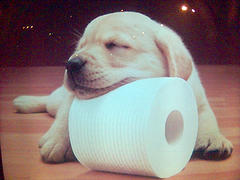 Puppies love toilet paper. They love to grab it and then run downstairs and all around the house dragging that playful unrolling paper until it totally runs out. Fortunately, my new puppy hasn’t discovered The Important Room just yet, but I’m sure it will be just a matter of time.
- Toilet paper is great for cushioning packages sent to your college student who lives off-campus. It not only keeps those fresh-baked cookies from crumbling, it can be used for its intended purpose upon arrival (assuming you’ve packed the rolls without unwrapping them first – really, I shouldn’t have to point that out). Most college students are very appreciative of such consideration – they’ll have that much more cash to pay for beer.
- Got a neighbor you really hate? Wait until a dark, rainy night and throw TP at their house. Rain is a necessary ingredient to make the paper stick properly. While I’ve heard about this method of socializing, I have never personally participated in the event, although I suspect my house could be a target real soon.
- If you find yourself moving, either suddenly or otherwise, toilet paper would make good packing material – see above, but without the beer. Or maybe with the beer after the move is completed and the kids are in bed.
- How about craft use? I’m thinking a doggie toy made with toilet paper stuffing might be a good idea. Too many dogs ingest the cottony type stuffing most toys come with, causing digestive problems. Toilet paper shreds so well that most dogs would rather do that than eat it, and I’m pretty sure that any small pieces that might be ingested would pass through fairly easily. Nevertheless, ALWAYS watch your puppy or dog with a new toy.
- Another crafty use, if you’ve run out of cotton balls, could be snowmen. Just roll that paper into tight little balls, glue the balls together, add toothpick arms, draw a face with marker, and voilà ! If the paper doesn’t roll into tight enough balls, I hear a little spit might help.
 Had enough? Of course not. We haven’t done the requisite internet search yet.
- Is it really necessary for Wikipedia to define toilet paper? And in such detail? Isn’t toilet paper, or TP, a household word already in most civilized societies?
- There’s even a “Toilet Paper World.” Seeing the name, I envisioned TP houses (don’t throw water balloons at others if you live in one), or maybe TP cars (if you want it to roll really well, attach it to a puppy), or possibly TP pets (cute little white fluffy kitties – when you get tired of them, just flush them away).
It’s a joke, people – I have no issues with cats . Hold off those nasty emails!
- And who could possible live with himself or herself if he/she didn’t buy the very best TP, as tested in Consumer Reports? Not that I personally agree with the results, but there they are.
***
Well, I myself have had enough of this post. And what with a flare-up of my ulcerative colitis, I need to spend some time in The Important Room now. Perhaps while I’m in there I’ll spot another item to be featured in a future post. I know y’all can’t wait!
__________
I love to hear from my readers. You may comment on this post, comment on my Facebook page, or email me at cordeliasmom2012@yahoo.com
__________
Images by: Erwin Fisser/fisserman, and Cheng-Yee/chickensdrawl, and Christopher/chriscorneshi, and Helen Haden/hehaden, respectively